Advertisement

OPINIONS
6-Month T-Bill 2025 Year End Projection Review and Auction Trend Analysis
Year end review on the 6-month T-bill projection results and auction trend analysis.
Tan Choong Hwee
Edited 23 Dec 2025
Investor/Trader at Home
This Opinion post first appeared in my blog here: https://pwlcm.wordpress.com/2025/12/23/6-month-t-bill-2025-year-end-projection-review-and-auction-trend-analysis/
Disclaimer: This post is just for educational sharing purposes. Please do your own due diligence on any products mentioned in this post.
__
With the last 6-Month T-Bill of the year closed on 18 December 2025, now is the time to do a Year End Review.
Here is the tabulation of the projection results in 2025:
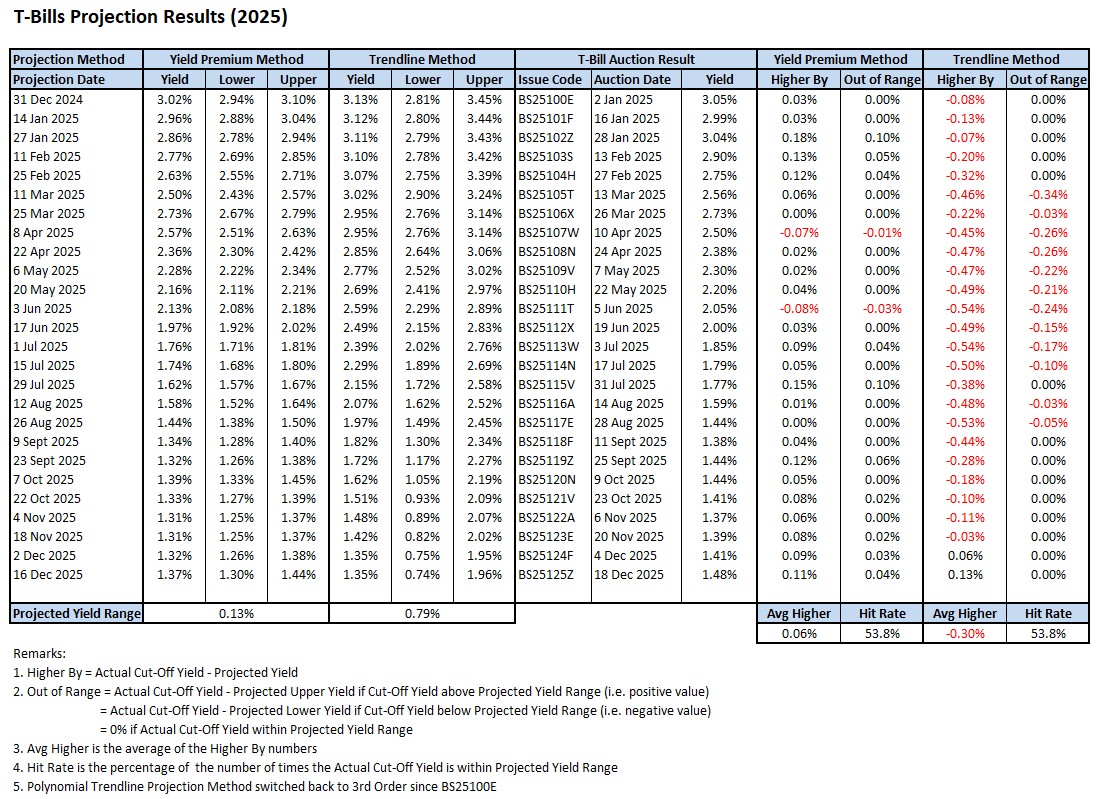
Both the Yield Premium Method and the Polynomial Trendline Method yielded the same hit rate at 53.8%. But when I look at the Projected Yield Range of the 2 methods, the former has a much tighter average projection range (0.13%) versus the latter (0.78%), meaning Yield Premium Method is the sharper shooter in yield projection.
In terms of deviation of actual yield from projected yield, Yield Premium Method on average only underestimated by 6 basis points, whereas Polynomial Trendline Method overestimated by a larger deviation of 30 basis points.
This is expected due to recency influence because Yield Premium Method is based on institutional sentiments derived from the MAS Bill auction results just 1 or 2 days prior to the T-Bill auctions.
Here is the 6-Month T-Bill vs 12-Week MAS Bill Yield chart from 2022 to 2025:
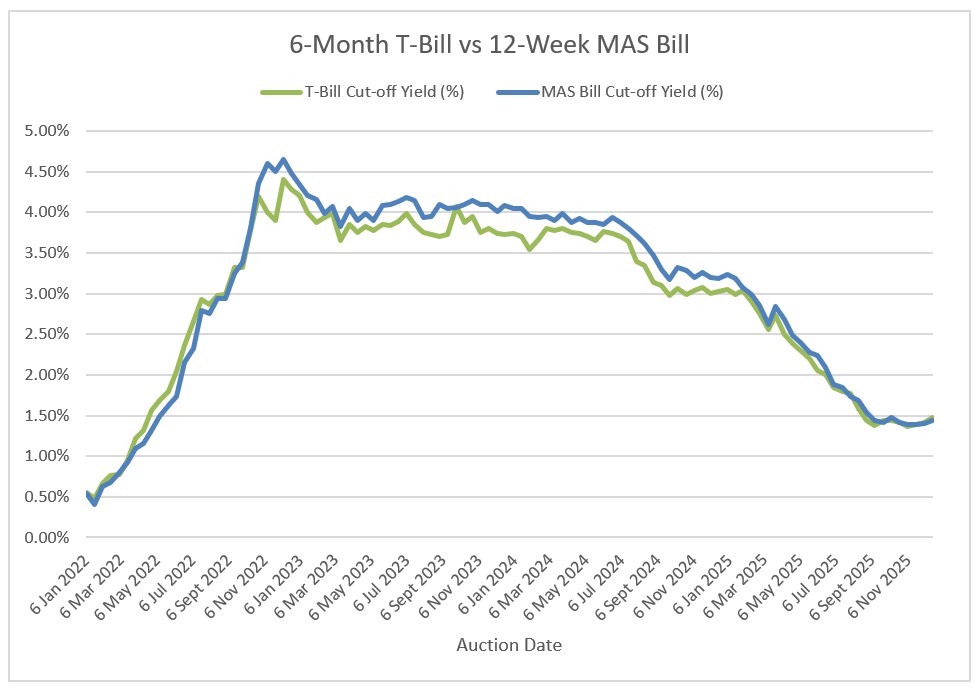
Initially the yield premium was pretty small in 2022, I believe attributing to mostly institutions are participating in T-Bill auctions, and their bids are similar to their bids for MAS Bills.
When T-Bill yield raised above 4% in October 2022, it piqued retail investors interest and attracted many of them jumped on the bandwagon. Being new to the game, most would simply place non-competitive bids because they had no idea what yield level to place for competitive bids. We saw that the non-competitive applications were over-subscribed in the November 2022 issues and the non-competitive bidders were getting partial allotment.
After learning the lesson on not getting full allotment for non-competitive applications, more retail investors learnt to place competitive bids, and some of them might have resorted to low balling the bids in order to secure allotment. As a result of low balling, the T-Bill yield went lower than the MAS Bill yield, resulting in the widening yield premium from end 2022 to early 2025.
When T-Bill yield declined below 3% in early 2025, retail investors started to lose interest and the yield premium narrowed. We could see from the chart that the T-Bill yield curve tracked closely to the MAS Bill yield curve since the yield dropped below 3%.
Similar widening and narrowing trend could be seen in the chart showing T-Bill cut-off yield, median yield and average yield:
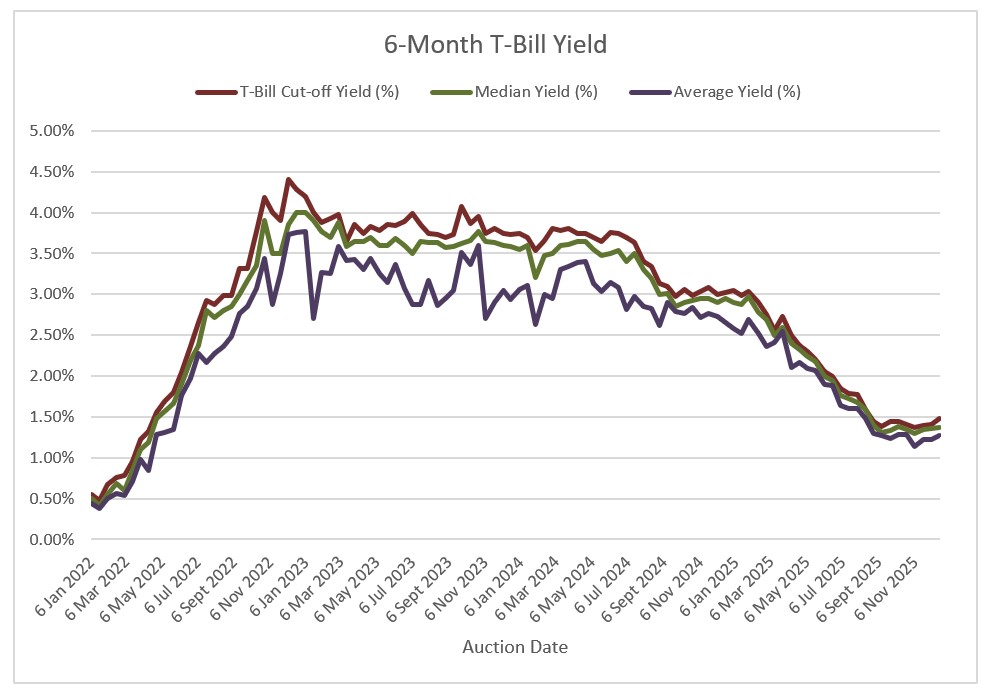
During the bulk of 2023 and 2024 period, the gap between median and average yields were generally wider than the gap between median and cut-off yields. This means there were some low bids that pulled the average yield down, a sign of low balling.
This phenomenon could also be seen in the following Yield Premium Statistics:
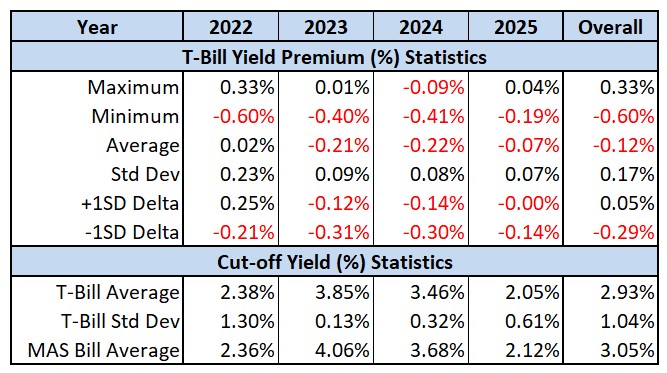
The average yield premium was slightly positive in 2022, widen to slightly more than 20 basis points negatively (i.e. T-Bill Yield below MAS Bill Yield) in 2023 and 2024, and back to negative 7 basis points in 2025.
This trend shows that the retail investors were getting more matured in bidding for T-Bill. Moving forward, I believe the yield premium trend is likely to continue, with small negative yield premium being the norm in 2026 and beyond.
In summary, the steps to do 6-Month T-Bill yield projection based on Yield Premium Method are:
- For each 6-Month T-Bill issue, take note of the auction results of the 12-Week MAS Bill happened just 1 or 2 days prior to the T-Bill auction date.
- Add the Average Yield Premium to the Cut-Off Yield of the preceding MAS Bill, that would be the Projected Cut-Off Yield of the coming T-Bill.
- Subtract and add the Standard Deviation of Yield Premium to the Projected Cut-Off Yield of the coming T-Bill, that would give you the Projected Yield Range.
With that, I would stop publishing 6-Month T-Bill Yield Projection articles moving forward. Frankly it was getting repetitive and boring for me to continue writing these articles. You have all the information in this article (and the examples in all the previous projection articles) to do your own yield projection.
At this juncture, I would like to conclude my study of 6-Month T-Bill Auction Trend based on 4-Years of auction data (2022 to 2025). The study has shown that Yield Premium Method is providing a reasonably accurate projection on 6-Month T-Bill Cut-Off Yield.
Wish you every success in T-Bill investment!
Comments
87
26
ABOUT ME
Tan Choong Hwee
Edited 23 Dec 2025
Investor/Trader at Home
Blogger, Investor
87
26
Advertisement
No comments yet.
Be the first to share your thoughts!