Advertisement


OPINIONS
4 Types of Corporate Actions that Investors should know
& why it's important
Although it is important to know about a company’s financial performance and growth prospects, there is one more area that investors should also be familiar with – Corporate Actions.
In general, corporate actions are schemes initiated by the board of directors that will affect its share price. Some actions will move prices in a positive way while others may trigger a negative market response.
Given that there are several different types of corporate actions, investors need to understand them in order to respond well to each of them i.e. subscribe to rights issue or lapse the offer.
Below, we will look into the 4 common types of corporate actions.
1) Dividends
Income-hungry investors in Singapore probably love this ‘corporate action’ the most.
When a company pays dividends to its shareholders, they are essentially receiving a portion of the company’s earnings or retained earnings at specific periods, usually quarterly or annually.
In addition, there are 4 important dividend-associated dates to know as well:
- Dividend Declaration Date: This is the date on which the board of directors issues a statement to declare a dividend.
- Ex-Date/Ex-Dividend date: The ex-dividend date is the first date that a share trades without the dividend. In other words, only shareholders who own the shares before the ex-dividend date are entitled to the dividend.
- Record Date: This is when the company decides to review the shareholders register to list down all the eligible shareholders for the dividend. Usually, the time difference between the dividend declaration date and the record date is 30 days.
- Dividend Payout Date: The last date is when the dividends are paid out to shareholders and investors will receive either the stock dividends or cash dividends (ka-ching!).
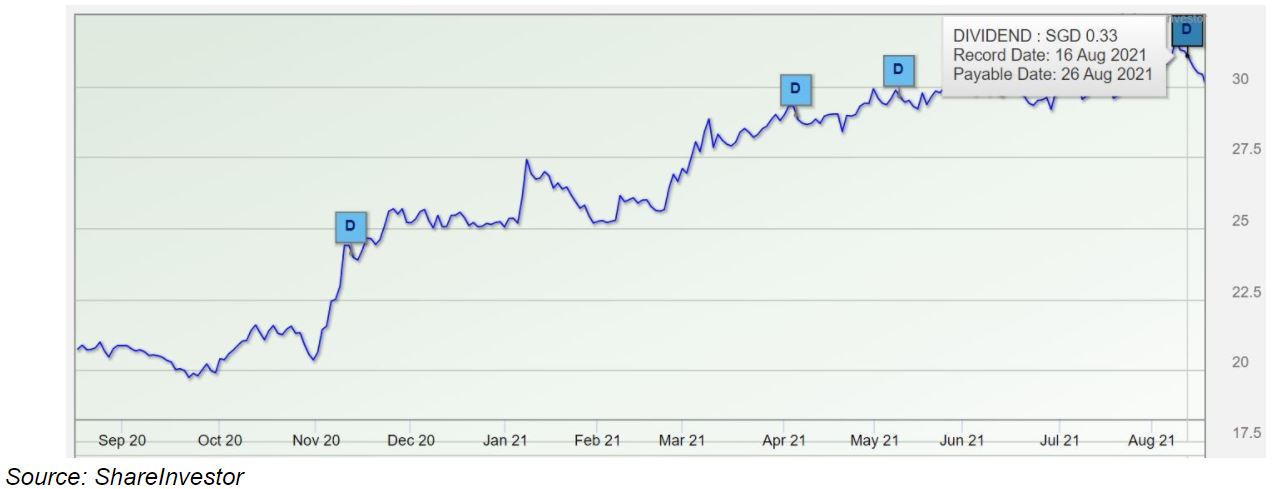
Based on DBS Group’s dividend payout chart shown above, shareholders who own DBS shares before 16 Aug 2021 are entitled for the latest dividend of 33 Singapore cents. Depending on whether the shareholders opt for cash or stock dividend, he will receive this equivalent dividend on 26 Aug 2021.
2) Rights Issue
During this Covid-19 pandemic, many cash-strapped companies such as mm2 Asia and Sembcorp marine are turning to rights issues to raise fresh capital.
The idea behind this is simple – the company approaches its existing shareholders and allow them to take up the rights issue in the proportion of their shareholding.
For example, a 1:3 rights issue means every 3 shares a shareholder owns; he can subscribe to 1 additional share. Needless to say, the new shares under the rights issue will be issued at a lower price than what prevails in the markets.
On the other hand, it should not be mistaken for the ‘private placements’ usually conducted by Singapore REITs too.
A private placement is when a company issue shares to a select group of investors, instead of all the shareholders in one scoop. By and large, it is a faster way of raising capital, as a company must comply with fewer requirements and the REIT doesn’t have to offer the same preferential but dilutive terms to all the shareholders at one go.
3) Company Shares Buyback
Mentioned in our past article, share buybacks, or share repurchases, refer to a company repurchasing its own shares from the open market.
Share buybacks are frequently used by the top brass to reduce the number of shares outstanding because of the reasons below:
- Improve the profitability on a per-share basis
- To consolidate their stake in the company
- To prevent other companies from taking over
- To show the confidence of the promoters about their company
- To support the share price from declining in the markets
In short, a share buyback signals a vote of confidence in the company itself and is usually deemed positive for the share price.
4) Bonus Issue
Another common type of corporate action is the bonus issue. A bonus issue is a stock dividend allocated by the company to reward the shareholders.
These are free shares that the shareholders receive against shares that they currently hold and these allotments typically come in a fixed ratio such as 1:1, 2:1, 3:1, etc. If the ratio is 2:1 ratio, the existing shareholders get 2 additional shares for every 1 share they hold at no additional cost.
One important note is not to be mistaken with rights issues because the latter would require the existing investors to pay up for the new shares at a discounted price.
Companies typically issue bonus shares to encourage retail participation, especially when the company’s price per share is very high, and it becomes tough for new investors to buy shares.
By issuing bonus shares, the number of outstanding shares increases, but each share’s value is reduced and in theory, the face value remains unchanged.
Here’s an illustration by using Riverstone’s 1:1 bonus issue on 10 Nov 2020 as an example. If you own 1,000 shares at $1.90 on 9 Nov 2020, your initial investment is $1,900. After receiving another 1,000 shares (1:1 bonus) the next day, your cost price of $1.90 will be divided by 2 to $0.95 and your total cost remains unchanged at $1,900.
Conclusion
To sum up, corporate actions are important source of indicators for the retail investors to monitor the company’s direction and effectively, the share price.
Different types of corporate actions can have varying impact on stock prices so it is more important to understand the underlying details of each corporate action.

More than 3,500 investors are on our Telegram, what are you waiting for? Join us now for more first-hand updates, articles, events, promos and happenings. Click here now.
See you on the inside.
Comments
62
1
ABOUT ME
A portal that provides a holistic approach to assess SGX listed companies through a wide array of viewpoint.
62
1
Advertisement
No comments yet.
Be the first to share your thoughts!