Advertisement


OPINIONS
4 Thoughts on Personal Finance & Investing You Have to Know in Your 20s [Part 1 of 2]
Time is a very important asset of yours. Start early, and use it to your advantage!

Source of image: Pinterest.
Author's note: This is a repost of an article written five years ago in 2016 (but the concepts are still timeless) by Fun Liang on Medium, who has since co-founded MoneyWiseSmart.com and writes there now.
__
Before you read on, let me set the expectation right. This post is not about ground-breaking investment strategies or the next big investment idea that you haven’t heard of before. This post is about four simple thoughts that I think would help you in building a strong foundation for your subsequent investing journey. You might have already known about them, but I find them so important and easily overlooked that it’s worthwhile to discuss about them here.
Thought #1 — Don’t rush. The power of compounding, coupled with a simple investing strategy can get you far enough
Investing to grow your wealth needs not be difficult and complicated.
I am not saying that it’s easy. I am saying that it needs not be difficult and complicated. It can be as simple as coming up with a simple investing strategy that matches your risk-reward profile and then leveraging on the power of compounding to grow your wealth.
To fully understand my point, we have to first understand the concept of compounding. It’s a very simple concept.
Let’s say you invest $1 today and the annual interest is 10%. One year later, you have $1.10. Two years later, you have $1.21 instead of $1.20, as the interest that you earn in the first year will give you interest too. It’s as simple as that.
I’m sure most of you have heard of the power of compounding. If not, let me repeat the words of one of the smartest person in history.
“Compound interest is the eighth wonder of the world. He who understands it, earns it … he who doesn’t … pays it.” — Albert Einstein
So exactly how powerful compounding is in helping us to grow our wealth?
Let’s do some (simple) math now. Meet Bob:
Bob has just graduated from university and is working as an engineer;
Bob earns a monthly income of $3,000;
Bob spends $2,000 every month, so he saves $1,000 every month, i.e. a savings rate of 33%;
Bob invests his savings annually, i.e. he invests $12,000 every year; and
Bob is able to predict the future. He knows that he would get an annual return of 6% on his investment amount every year.
Now let’s make a guess. After 30 years, i.e. after having put in a total of $360,000, how much would Bob have in total, assuming he reinvests all the returns/interests that he gets every year?
Make your guess now before you read on...
The answer is slightly over $1 million! Almost triple the amount that he puts in.
At this point, I have a question for you. Do you think you can be like Bob, saving a fixed amount of $1,000 every month and investing the savings annually, for the next 30 years?
If your think you can, good news for you. Assuming that you are 25 (my age) this year, you would have your first million by the age of 55. And note that I am assuming a reasonable and realistic 6% annual return and a constant saving of $1,000 only (remember that you income will go up as you grow older and progress in your career). (At this point, I would highly recommend you to quickly pull up your Microsoft Excel, plug in your own numbers based on your circumstances, and work out the results for yourself. This is crucial if you really want to understand where the power of compounding can bring you based on how much you can/are willing to put in.)
See the power of compounding? The power of compounding can create millionaires from average people.
And see what I mean by investing needs not be difficult? It can be as simple as using the power of compounding, coupled with a simple investing strategy that can provide you an average annual return of 6%. The development of a strategy that gives you the annual return that you want may not be easy, but once you are done with that, what you need to do next is just to sit back and watch the power of compounding works its magic.
You might be thinking, if it’s that easy, why isn’t everyone practising this and becoming rich?
That’s because even though sitting back and letting the power of compounding works its magic is simple, it is not easy. It is not easy because it takes time, patience and a strong belief that it works.
Compounding doesn’t happen overnight. It takes time. And when I say time, I mean a few years, a few decades, which is in fact a very long time.
And during this long period of time, it’s not easy to keep your eyes set on the long-term results and stick to your initial plan, of using a simple investing strategy and the power of compounding, because it seems too simple and you can’t see the results yet.
There are all sorts of things that can make you divert from your plan. For example, the results in the first few years would not be impressive and you might be thinking: “Is 6% annual return really enough to get me to where I want to be financially? My friends have been discussing about an investment opportunity that gives 50% return in 2 years. Maybe I should ask them about that and consider changing my plan. Anyway, the results that I have have been so so only thus far…”
All sorts of thoughts and doubts start popping up in your mind, even though in the first place, no one says you would be see impressive results in the first few years. There is nothing wrong with your initial plan. Your initial plan says that you would achieve your first million in 30-years-time based on an annual return of 6%, not in a few years! What has changed is your own expectations.
This is why I say using a simple investing strategy and the power of compounding to grow your wealth can be simple, but not easy. You have to have the belief (and I mean strong belief) that it would work and strong control over your emotion so as to hinder the short-term noises and distractions (for e.g. get-rich-fast schemes or the next-big investment opportunity that everyone is talking about) from taking you off your original plan.
You have to understand that as long as your investing strategy is giving you the annual return that you have put in in your spreadsheet when you formulated that strategy, even though that annual return rate suddenly “appears” low now, especially when your peers are talking about a much higher return (even though they might not have achieved them consistently for many years), you are fine. You just have to stick to your strategy and allow time for compounding to take you there.
“Successful investing takes time, discipline and patience. No matter how great the talent or effort, some things just take time: You can’t produce a baby in one month by getting nine women pregnant.” — Warren Buffett
Even Warren Buffett, one of the most successful investor and richest man in the world, says that “successful investing takes time, discipline and patience… some things just take time”.
So I would suggest that, finding a simple investing strategy that matches your risk-reward profile and provides you with a good-enough return based on your investment goals, and sticking to it over time for compounding to take its effect, may be a better way to go, as compared to going after more complicated investing strategies or ideas that promise much higher returns.
If you have totally no clue as to what returns to expect, here are some numbers. From 1965 to 2015 (50 years), Warren Buffett’s Berkshire Hathaway had achieved an average annual return of 21.6%, while the average annual return for the Standard & Poor’s 500-stock index (a proxy for the US market), with dividends included, was 9.9%. If you think you can do better than Warren Buffett or the market (most people, including professional investors and mutual/hedge funds worldwide don’t outperform the market consistently), then go for double-digit returns. If not, then I would highly recommend you to manage your expectations and aim for more reasonable returns.
Remember: Don’t rush. The power of compounding, coupled with a simple investing strategy can get you far enough.
“It is not necessary to do extraordinary things to get extraordinary results.” — Warren Buffett
Thought #2 — “Time” is a very important asset of yours. Use it to your advantage
If you are in your 20s, congratulations! You have one very important asset that many other people don’t (and are dreaming for).
That asset is called “time”. Because when you have time, you can afford to structure your investing strategies based on very long time horizons.
Let’s say you are 25 years old now. Take away the large cash-flow hit upon marriage and purchase of your first house and car, and assuming you are going to have active sources of income (e.g. working), most of your savings can be invested for very long time horizons, as most likely you won’t need them until retirement (provided you plan your cash flows properly and have insurance in place to cover for the unexpected happenings).
By very long time horizons, I mean 10 years, 20 year, 30 years, or even more. And this is a very strong advantage if you are investing for the long term (i.e. you are going for value investing or growth investing, and not technical trading).
Why so? Because most asset classes (for example equities) tend to go up in the long run. I am not saying that it definitely goes up in the long run, but the chances are higher if your time frame is longer.
Let’s take a look at the chart for S&P 500 index over the past 35 years since 1980.
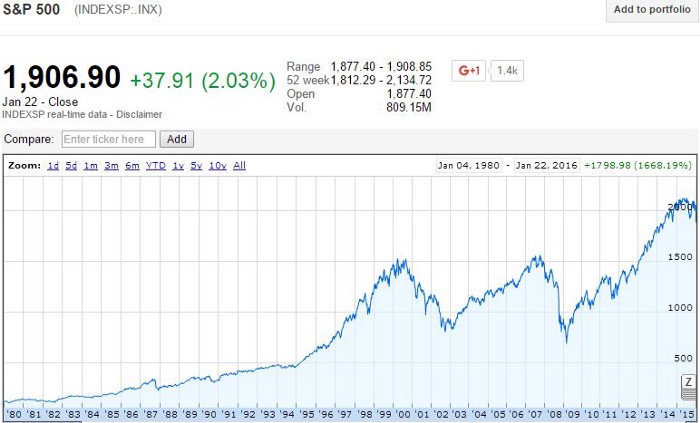
Source: Google Finance (on 22 January 2016).
No matter which point you take in this chart (excluding those in the last few years as they are not considered “long-term”), the capital value (i.e. the share price) of S&P 500 has increased (note that this is excluding the dividends that have been paid out).
Even if you had invested in the S&P 500 during the peaks in 1999 before the dot com bubble or in 2007 before the global financial crisis, you would still come out fine today, after 17 years and 9 years respectively. You might not get the best returns, but you would come out fine. The same pattern can be seen in other major well-diversified world indices. (Note: The long-term upward trend applies to most asset classes in totality, and not necessarily so for individual assets. Further, “long-term” can be very very long. For example, as of today (26 January 2016), the value of Nikkei Index, which is a proxy for the Japanese market, is still less than half of its peak in December 1989, so “long-term” can be very long, even much longer than 26 years.)
As a common investor saying goes, “time in the market is more important than timing the market”. That’s why “time” is a really great asset of yours that you can (and should) utilise, even though its greatness is often overlooked by the people in the 20s (and can only be dreamed of by the very experienced investors in their 50s or 60s who have all the skills and knowledge, but not so much the time anymore).
When you have time, you can afford not to exit the market and hold your investments through the economic crises and cycles that are inevitable parts of economy because you are not out of time and don’t need the liquidity. (Note: I am not advocating that you should hold on to your investments blindly throughout the downturns. For example, if you are into equities, you should always check that the fundamentals and balance sheets of the companies are still strong and solid and can tide them through the down periods.)
Remember: Time is a very important asset of yours. Use it to your advantage!
“In the short run, the market is a voting machine, but in the long run it is a weighing machine.” — Benjamin Graham
P.S. If you have enjoyed this article, we would appreciate if you can like and share it!
We are sure you will enjoy other investing content at MoneyWiseSmart website too!
Comments
361
4
ABOUT ME
We believe the society will be better with better financial and investment education, which is what we offer. Check us out.
361
4
Advertisement
No comments yet.
Be the first to share your thoughts!